
Heads up: Some of the links below are affiliate links. That means if you click and buy, I may earn a small commission (at no extra cost to you).
Key takeaways
- Artistic swimming requires a unique combination of athleticism, artistry, and endurance.
- Routines must appear effortless—an illusion achieved through grueling training.
- Competitions are judged on both technical execution and artistic interpretation.
- The sport has been part of the Olympic Games since 1984.
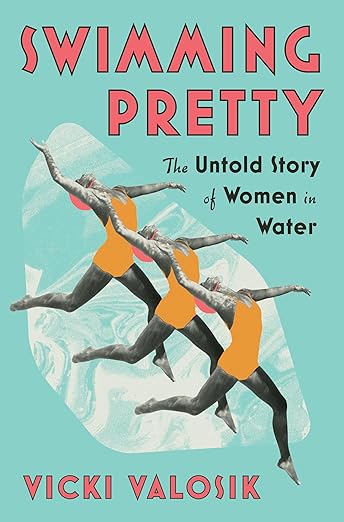
Swimming Pretty
(affiliate link)
Vicky Valosik wrote this amazing book telling the history of synchronized swimming in great detail!
What Is Artistic (Synchronized) Swimming?
Once known as “water ballet” and made popular in Esther Williams’ Hollywood films, artistic swimming has evolved into a demanding Olympic sport. Modern artistic swimmers combine:
- The grace of a ballerina
- The strength and flexibility of a gymnast
- The speed of a competitive swimmer
- The lung capacity of a pearl diver
- The stamina of a distance runner
- The precision of a synchronized team
All while holding their breath, interpreting music, and executing perfect choreography.
“It Looks So Easy!” — But It’s Not
One of the sport’s most striking qualities is how effortless it appears. But behind that elegance lies intense physical exertion.
Imagine This:
- A gymnast performing a beam routine underwater
- Holding her breath for half the performance
- Now add seven more gymnasts performing the same routine in sync
That’s what artistic swimmers do.
The Intense Training Regimen of Artistic Swimmers
Elite artistic swimmers often train up to 8 hours a day. Their schedule includes:
- Pool time to refine choreography and synchronization
- Weight training for strength
- Flexibility and conditioning exercises to enhance movement and endurance
- Breath-holding drills to improve lung capacity
Synchronized Swimming Competition Categories
Artistic swimming includes the following categories:
- Solo performances
- Duets
- Teams (usually 8 swimmers)
Olympic History of Artistic Swimming
- 1984: Became an Olympic sport with solo and duet events
- 1996: Team event replaced solo and duet at the Olympics
- 2000: Duet and team events were reinstated—still the format used today
How Artistic Swimming Is Judged
Competitions are split into two main parts:
1. Figures/Elements Competition
- Swimmers perform technical moves individually, without music
- Judges score each movement based on precision and technique
2. Routine Competition
- Swimmers perform choreographed routines to music
- Judging criteria includes:
Technical Merit
- Synchronization
- Time spent underwater
- Height of movements above the water
- Difficulty of techniques
Artistic Impression
- Grace and elegance
- Choreography’s connection to music
- Overall presentation
Scoring:
- A percentage of the figure score is combined with a percentage of the routine score to determine the final score.
FAQ: Artistic (Synchronized) Swimming
Who invented synchronized swimming?
Synchronized swimming evolved from water exhibitions in the early 1900s, but Katherine Curtis is credited with developing it into a competitive sport in the 1920s and 1930s in the U.S.
Is there men’s synchronized swimming?
Yes! While traditionally dominated by women, men now compete in mixed duet and team events. Since 2015, men have been allowed to compete in FINA World Championships, and men’s team events will debut at the 2024 Paris Olympics.
How deep is the pool for synchronized swimming?
The pool must be at least 3 meters (approximately 10 feet) deep to allow for safe underwater movement and high lifts.
When did synchronized swimming become an Olympic sport?
Synchronized swimming debuted at the 1984 Los Angeles Olympic Games, featuring solo and duet events.
Want to learn more about Synchronized Swimming?
Swimming Pretty, (affiliate link), a book by Vicky Valosik, covers the history of the sport in great detail!

 Swim in sync
Leave a comment